
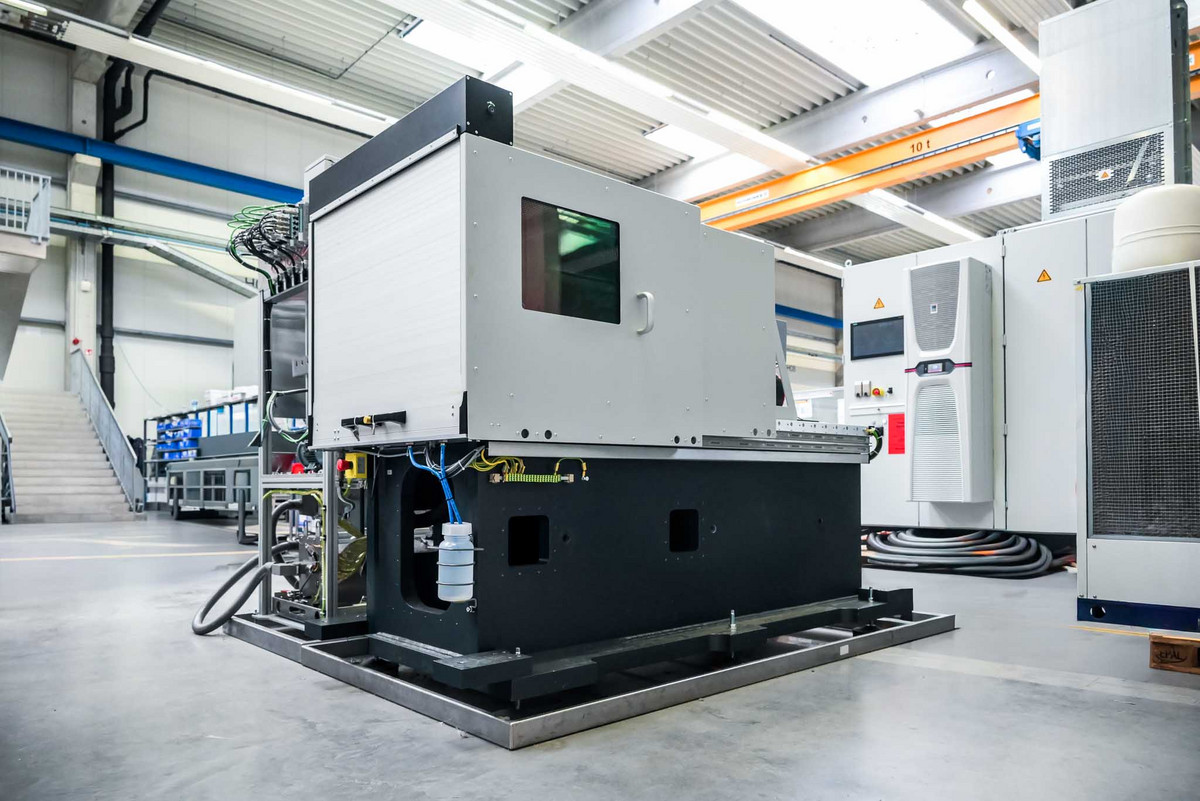
FZG High-Speed Gear Tension Test Stand
Electric drives rotate at over 20,000 rpm. Their gear oils are tested at about one-tenth of that speed. The FZG high-speed gear stress test bench closes this gap—at 22,500 rpm on the pinion and using standard FZG geometry—ensuring that established FZG standard tests remain valid.
Design and Operating Principle
The high-speed FZG test rig is based on the standard FZG test rig. This, too, is a test machine with a power circuit. The transmission and the test gearbox are connected by a drive shaft assembly and a torsion shaft. A tension coupling is mounted on the drive shaft assembly to apply the load. The torque is measured at the torsion shaft. The test rig is driven by a speed-controlled induction motor. The associated oil unit for injection lubrication features a cooling and heating system that maintains the test transmission oil at the desired temperature. The temperature of the transmission oil can be preset and monitored.
With an axle distance of 91.5 mm and a gear ratio of 1.5, the test rig complies with the FZG standard geometry; FZG-specific test wheels can be used.


Highlights and Exams
- High speed at the pinion (22,500 rpm)
Sump and injection lubrication
- Separate oil circuits for the transmission and test gearbox
- Use of FZG-specific test gears is possible
- DGMK 833 / FVA 988 I “E-Fluids@HighSpeeds”
- Additional test procedures currently being developed at TUM (FZG)
- Structure-borne noise vibration monitoring
- Measurement data available in .tdms format
- Variable threshold monitoring
Technical Specifications and Features
- Max. speed at the pinion: 22,500 rpm
- Max. torque: 600 Nm
- Max. power in the tensioning circuit:
- Current: 942 kW (22,500 rpm & 400 Nm at the pinion)
- Target: 1,413 kW (22,500 rpm & 600 Nm at the pinion)
- Gear ratio: 1.5
- Center distance: 91.5 mm
- Shaft diameter of test transmission: standard Ø30 mm
- Transmission oil temperature: water-cooled
- Efficiency: 60°–140°C
- Seizure test: Depends on the power in the load circuit
- Oil temperature of test gearbox: 60 °–140 °C (controlled, cooled, and heated).
- Holding temperature for injection lubrication: 60°–140 °C
- Oil flow rate: 0.3–5 l/min
- Overall space requirements (L x W x H):
- Test rig: approx. 2.3 m x 1.4 m x 1.8 m
- Oil unit: approx. 1.6 m x 1.2 m x 2.0 m
- Weight:
- Test rig: approx. 5.5 t
- Oil unit: approx. 550 kg

Direct Inquiry