
FZG Test Rig for E-Fluids: Gear Oil Testing at 22,500 rpm at the Pinion
Electric drives run at more than 20,000 rpm. Their gear oils are still evaluated at around a tenth of that speed. With the FZG high-speed back-to-back gear test rig, Strama-MPS closes this gap – while retaining comparability with the established FZG standard tests.
An order of magnitude between test and application
Anyone qualifying a gear oil for the automotive industry ends up at one machine: the FZG back-to-back gear test rig. For decades it has been the reference point for scuffing load capacity, wear behavior and micropitting. The associated test methods originate from the Gear Research Center (FZG) at the Technical University of Munich and are internationally standardized today.
The rig was developed for a drivetrain world in which combustion engines set the speed. In the classic standard test, the pinion runs at around 2,250 rpm. That was appropriate – as long as the gearboxes being tested operated in a similar range.
Electric drivetrains do not. Today they reach 15,000 to more than 20,000 rpm, and the trend continues upwards, because higher speeds allow smaller, lighter and more efficient machines. Between the condition under which a gear oil is evaluated and the condition under which it works, there is therefore roughly an order of magnitude.
Why high-speed results cannot be extrapolated
It would be tempting to assume that results from the standard test can simply be scaled up. They cannot, because at high pitch line velocities effects dominate that play almost no role in the classic speed range:
- Oil distribution and churning losses. At high speeds, what matters is how much oil actually reaches the gear mesh – and how much of it is churned up in the sump. Dip and injection lubrication behave fundamentally differently here.
- Air entrainment and foaming. What is a boundary condition at 2,000 rpm can significantly affect lubricant film formation at 20,000 rpm.
- Very short contact times. Additives need time to react at the surface and build up protective tribofilms. At high over-rolling frequencies, that time is no longer available to the same extent.
- Low viscosities. Dedicated e-fluids are deliberately thinner in order to reduce losses. Their load-carrying reserves behave differently under high-speed conditions than in the familiar range.
- Thermal behavior. Higher power density means more heat input in a smaller space – often combined with a smaller oil volume.
For lubricant development this means that an e-fluid can perform unremarkably in the standard test and excellently in real operation – or the other way round. Either is a problem when approval decisions rest on it.
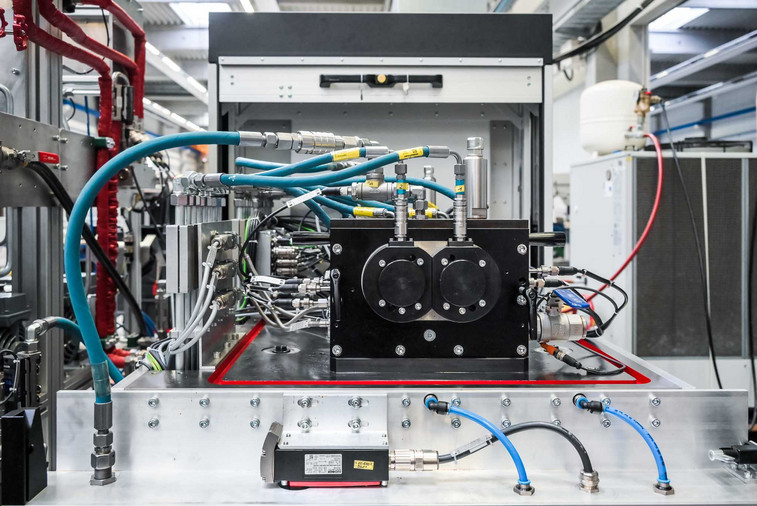
The FZG high-speed gear test rig in detail
The FZG high-speed back-to-back gear test rig from Strama-MPS reaches 22,500 rpm at the pinion at a maximum loop torque of 600 Nm. Under these conditions, the circulating power in the torque loop is 1,413 kW (22,500 rpm and 600 Nm).
What is decisive, however, is not only the speed but also the geometry: with a center distance of 91.5 mm and a ratio of 1.5, the rig matches the standard FZG geometry. Established FZG standard tests can therefore still be run and verified. Users do not get a second, isolated set of data – they get an extension of the one they already have, on the same test rig.
Added to this is everything that makes high-speed investigations of EV driveline fluids meaningful in the first place:
- Dip and injection lubrication, to evaluate both supply concepts
- Separate oil circuits for the test gearbox and the slave gearbox
- Oil flow rate from 0.3 to 5 l/min – down to minimum-quantity ranges
- Temperature control from 60 to 140 °C, with the test gearbox both cooled and heated under closed-loop control
Structure-borne noise and vibration monitoring that makes the condition of the gear mesh visible during operation
At roughly 2.5 × 0.9 × 1.7 m and around 3 t, the rig can be integrated into existing test facilities; the oil supply unit is added separately.
Developed in the Opt4E research consortium
The test rig was developed within Opt4E, a publicly funded collaborative research project in which industry and academia work together on the synthesis and optimization of electric drivetrains. The partners include the Gear Research Center (FZG) at the Technical University of Munich, alongside many others from research and industry.
This collaboration goes beyond the development phase: the test procedures for the high-speed range are currently being created together with the FZG. So this is not simply a machine that spins faster – it is the methodology that turns high speeds into robust, reproducible and comparable findings. That is exactly what the FZG has been working on for decades, and exactly what will allow the results to connect to the existing body of data.
For users, this means a head start: anyone working with the high-speed rig today gains experience with a methodology while it is being created, rather than adopting it afterwards.
Electrification has redefined many drivetrain components. The methods we use to evaluate their lubricants are only now catching up. With the FZG high-speed back-to-back gear test rig we supply the hardware – and together with the FZG at the Technical University of Munich, the methodology is taking shape.